
Mol A, and Law J, 'Regions, Networks and Fluids: Anaemia and Social Topology', Social Studies of Science
Text Presentation. Motion graphics
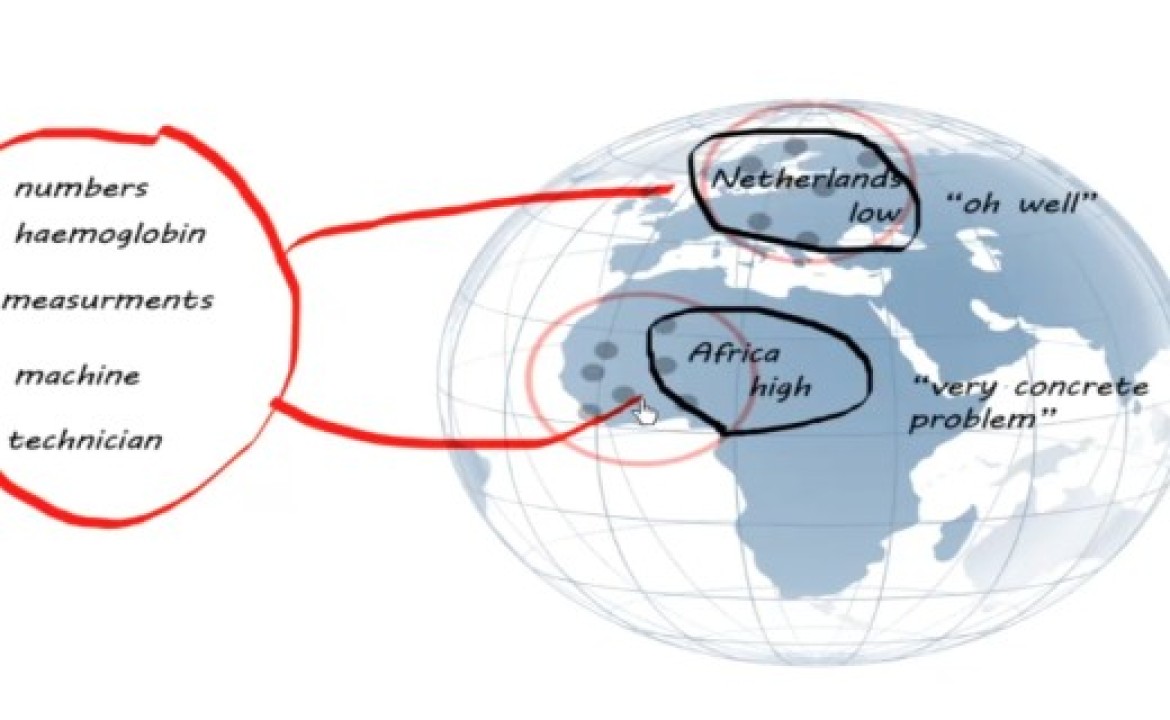
This is a paper about the topological presuppositions that frame the performance of social similarity and difference. It argues that 'the social' does not exist as a single spatial type, but rather performs itself in a recursive and topologically heterogeneous manner. Using material drawn from a study of the way in which tropical doctors handle “anaemia”, it explores three different social topologies. First, there are 'regions' in which objects are clustered together, and boundaries are drawn round each cluster. Second, there are 'networks' in which distance is a function of relations between elements and difference a matter of relational variety. These two forms of spatiality are often mobilized in social theory. However, we argue that there are other kinds of social space, and here considers the possible character of a third, that of 'fluid spatiality'. In this, places are neither delineated by boundaries, nor linked through stable relations: instead, entities may be similar and dissimilar at different locations within fluid space. In addition, they may transform themselves without creating difference. (Original book abstract)
(Original book abstract)
Mol, A. and J. Law (1994). "Regions, Networks and Fluids: Anaemia and Social Topology." Social Studies of Science 24: 641-671.
Fact Box
-
Alumni
- Paola Otero ()