 Apply
Apply
Apply
Apply
TBA21-Academy
The Art and Science department heads to the Augarten, past the trees and the grass to the TBA21 to meet TBA’s director of development/strategic affairs Kattiana Orluc and social scientist and Clemens Rettenbacher to discuss the TBA21-Academy and explore the exhibition Tidalectics.
...like the movement of the ocean she’s walking on, coming from one continent/continuum, touching another, and then receding (‘reading’) from the island(s) into the perhaps creative chaos of the(ir) future... – Kamau Brathwaite
Tidalectics is an oceanic worldview, a different way of engaging with the oceans and the world we inhabit. Unbound by land-based modes of thinking and living, the exhibition is reflective of the rhythmic fluidity of water and the incessant swelling and receding of the tides.
(TBA21 Website)
*Occupying the space are a range of artworks and interdisciplinary research approaches that grapple with the socio-political, biological and cultural entities of our oceans, aswell as traces of the globalised world that is entangled within it. The exhibition hopes to remind us how the ocean affects our life and how we effect the beings living in it. The exhibition was timed to coincide with the first-ever United Nations’ Ocean conference, held in New York from June 5-9th, 2017.
Clemens tells us about the TBA21–Academies involvement in researching the Pacific Ocean and engaging with local communities and organizations, with a program that goes beyond the exhibition space and brings the practice to science, conservation and exploration.*
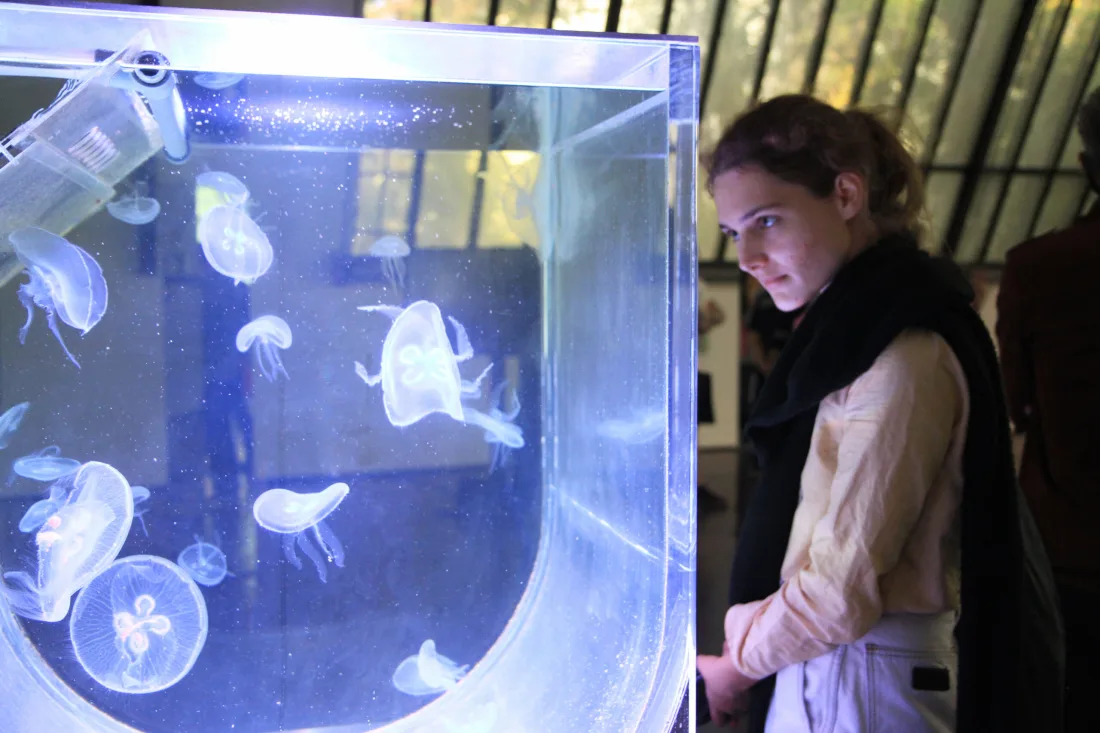
We take our time to watch Susanne M.Winterling’s installation and video Glistening Troubles (2016) from the artist’s residency at the TBA21 Alligator Head Foundation in Jamaica. The work investigates the bioluminescence of dinoflagellate algae as indicators for the health of coastal waters with toxic potential. Winterling’s long term research focuses on these organic bodies that light up when touched or moved, similar to the touchscreens that surround us today. We are reminded of the intertwined information between analog and virtual worlds. Tue Greenfort’s Tamoya Ohboya displays a living jellyfish, gliding in a tank, perhaps gazing at the exhibition viewers gawkingly so in return as they peer into the tank. Tamoya Ohboya, is the latin name for a type of 500 million-years-old jellyfish organism. The work invites us to ponder on the “more than human” characteristics of this creature, such as it’s unsual modes of reproduction and regeneration that differ from most other creatures we knoe, this could be thought to change common notions anthropocentric epistemiologies.