
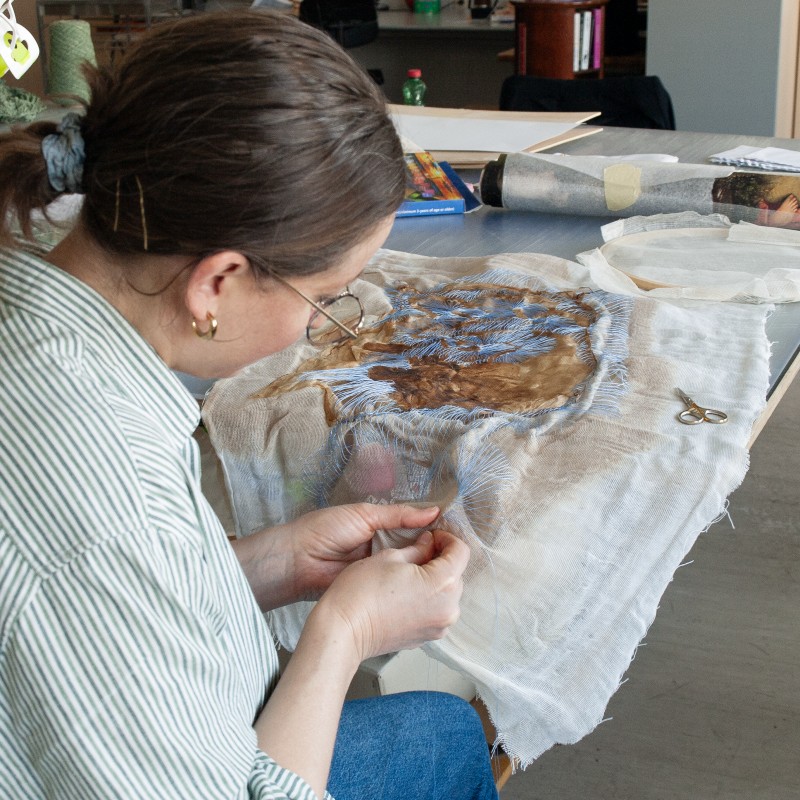
Monica at her studio © Gerda Fischbach, 2026
The only thing which is constant is change
Atelier Talk with Monica C. LoCascio
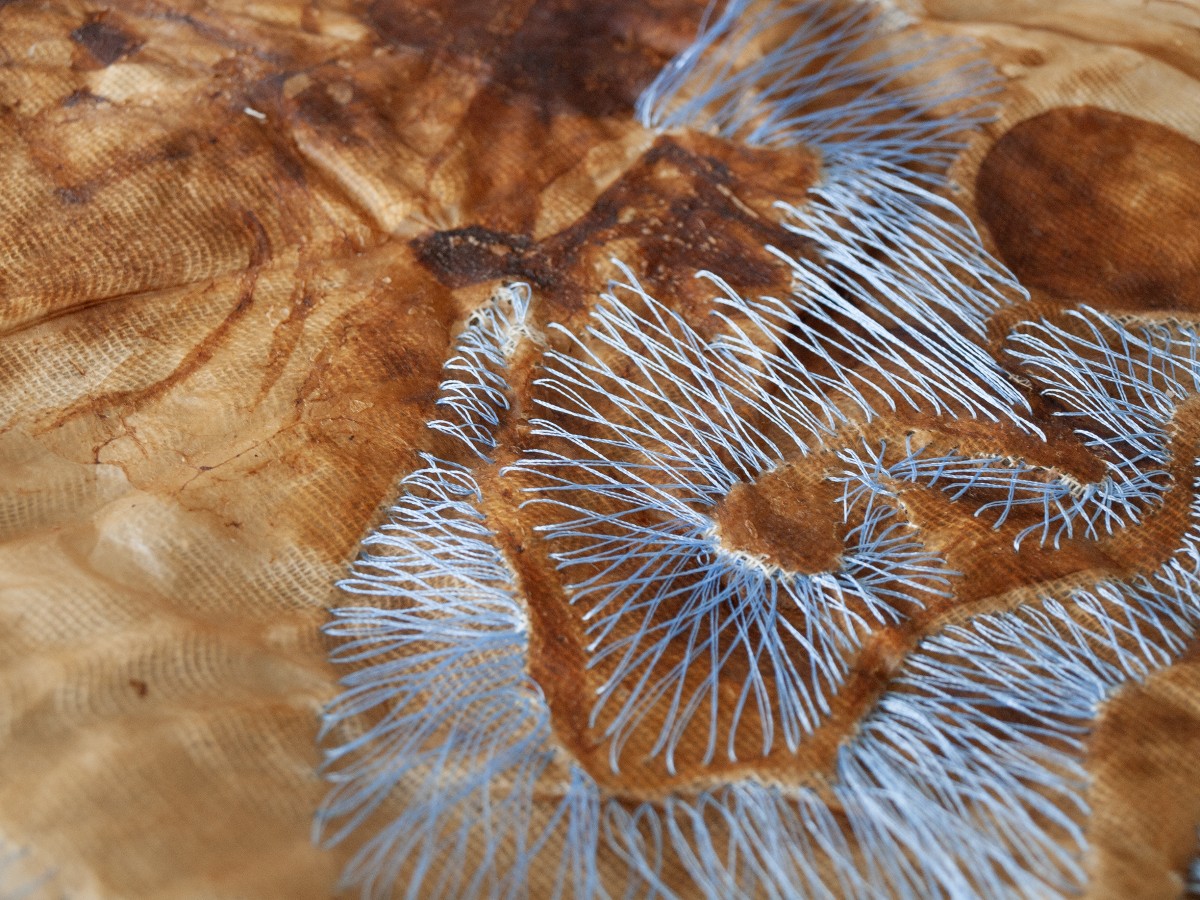
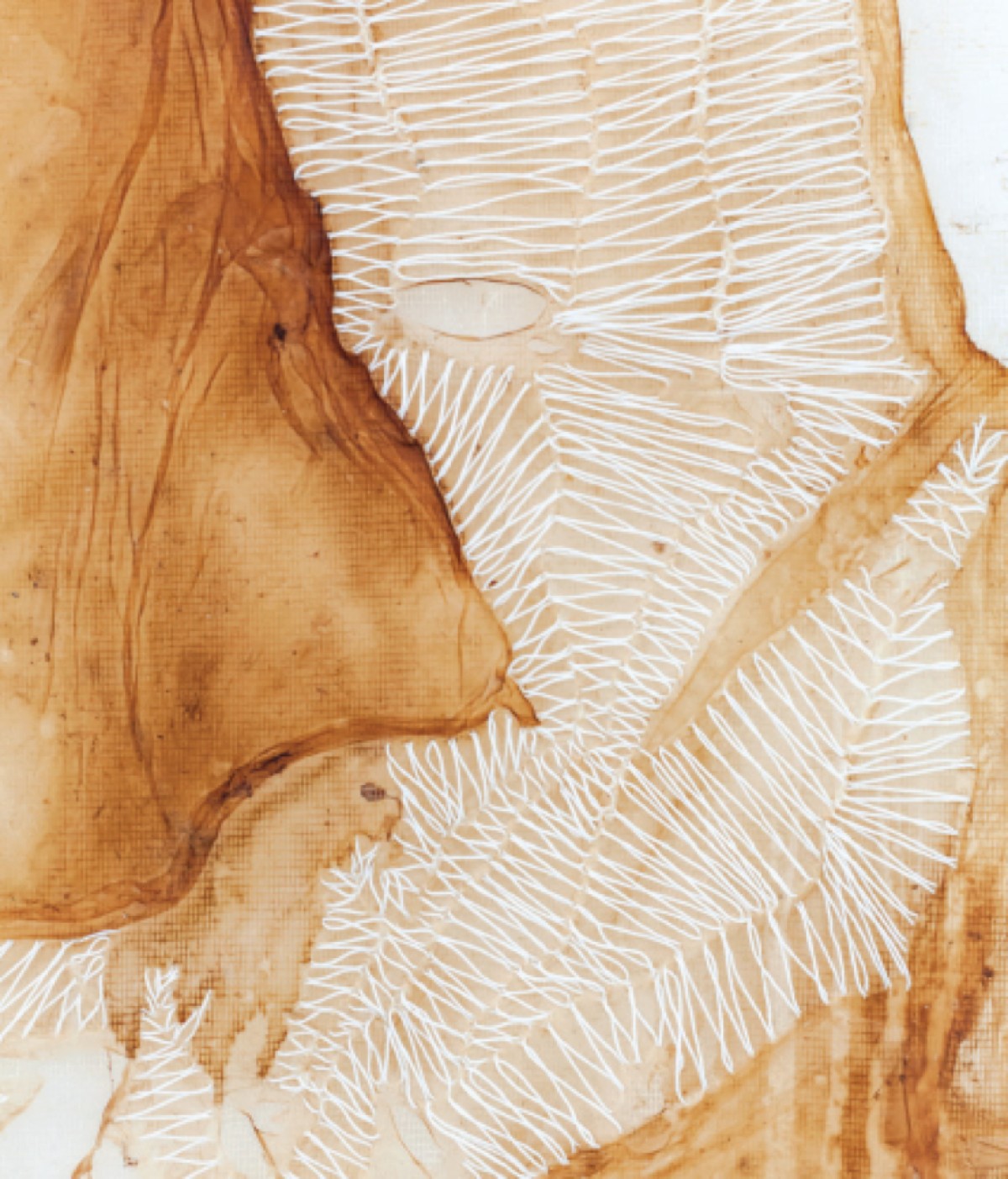
Covenant of Change, 2026 (detail) Hand-embroidered bacterial cellulose, polyester thread from my birthday, tea-stained Milano
cotton, 90 x 50 cm, Monica C. LoCascio, Photo © Gerda Tschoerdy Fischbach
Monica, thank you for having me here in your studio, embedded among other artists' studios. Am I right to assume that you like to work collectively?
I absolutely love working in collectives. Most of my artistic output is created alone, but I have several ongoing collective projects.
I founded bio:craft in 2021, a group composed of 4 artistic-researchers (myself, daniela brill estrada, Rychèl Thérin, and Mariella Greil), to research the healing communal power of embodied knowledge and craft practices. Together we explore the human and non-human body as a source of power, sovereignty, and agency within and against systems that aren't designed for coexistence and care. With our public facing presentations, we invite attendees to non-hierarchical discussions to honor and remember deeper lineages of care and creation.
"I insist on a shared studio space, and I try to be available to younger artists for support whether that is materially or
critically."
It is essential to my practice to share my material research and processes. I insist on a shared studio space, and I try to
be available to younger artists for support whether that is materially or critically. I also have an ongoing workshop series
in which I share my dedication to working with authentic, responsible materials. One focuses on tending microorganisms, fermentation,
and textile creation. Another on how to make a rudimentary loom, and weave with anything to create a tapestry of meaning.
Both touch on the somatic healing potential of the practices.
What is your current project?
A collaboration with my friend and long-term studio mate (we have been sharing a studio since my first year at A&S in 2017)
daniela brill estrada. Begriff des Körpers was developed during our residency with the GravityLab at University of Nottingham
with curator Ulrike Kuchner who we have both been working with since since 2018 when she included us in the Our Place in Space show with Hubble Telescope at NHM. The installation was first installed at the Djanogly Gallery at Uni. Nottingham, and then went on to the Science
Gallery in London. Soon we will install it at the Jodrell Bank Telescope Center in Manchester, UK.
What is your current project?
A collaboration with my friend and long-term studio mate (we have been sharing a studio since my first year at A&S in 2017)
daniela brill estrada. Begriff des Körpers was developed during our residency with the GravityLab at University of Nottingham
with curator Ulrike Kuchner who we have both been working with since since 2018 when she included us in the Our Place in Space show with Hubble Telescope at NHM. The installation was first installed at the Djanogly Gallery at Uni. Nottingham, and then went on to the Science
Gallery in London. Soon we will install it at the Jodrell Bank Telescope Center in Manchester, UK.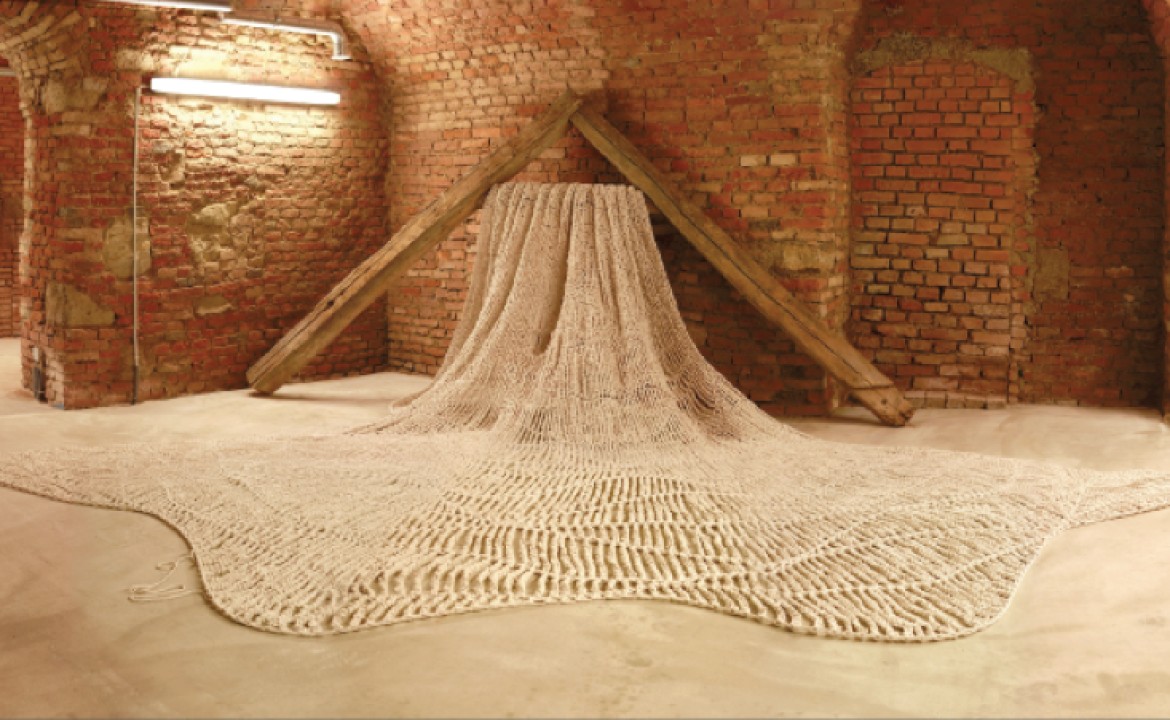
Generational Weight, 2021, Un-bleached organic cotton cord, salvedged barn support beams, 450 x 350 x 205 cm. Exhibition at minuszwei Vienna, Photo © Ivonne Gracia Murillo
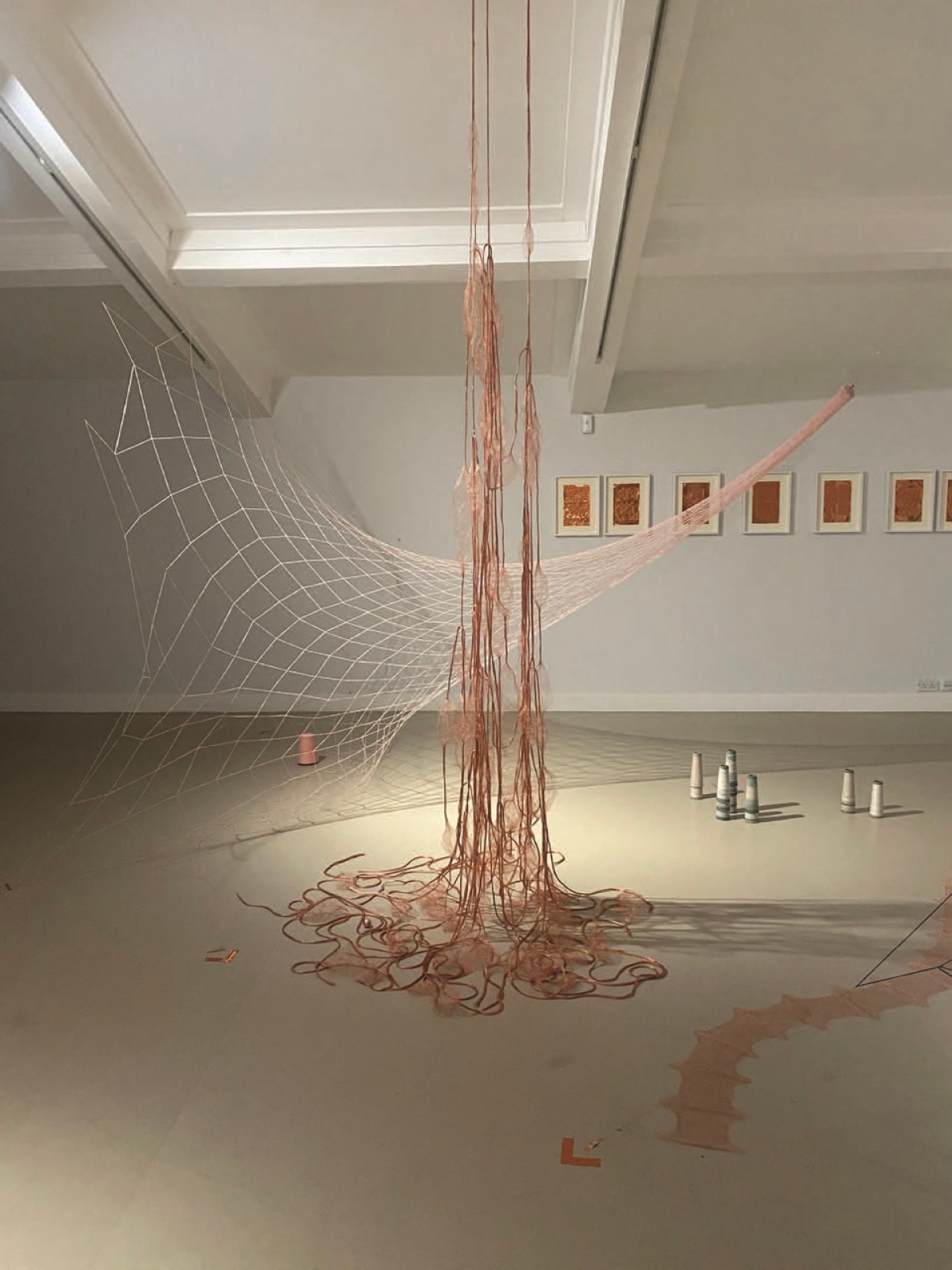
Exhibition view in Begriffe des Körpers together with daniela brill estrada, 2024-2025, Copper balls, garden netting, embossing foil, tape, wire, medallions, ball,
and ornament hooks, malachite, antique wool donated from the Framework Knitters Museum, thread cones from Cluny Lace Company,
magnets, paper. Dimensions variable.
Photo © Monica C. LoCascio
Photo © Monica C. LoCascio
"The limits of our bodies make it essential to develop apparatus to grasp ungraspable scales and timelines and study intangible
and invisible phenomena."
In September 2024, Daniela and I spent a week with the scientists at GravityLab at the University of Nottingham researching
black holes, dark matter and energy, and superstring theory. During this time, we also visited local lace factories and historical
textile mills. The language, metaphors, shapes, and materials from these visits all made their way into the installation artworks,
highlighting the site-specificity of the project.
On the 6th of June 1930, Albert Einstein visited the University of Nottingham to lecture on space and time, his theory of relativity, and understanding elements not by matter, but by space and direction. Inspired by the title of a section from that lecture, “Begriff des Körpers” (meaning both “comprehending the body” and “the term for the body”) reflects on the role and limits of the body in understanding the cosmos, and explores the aesthetics, metaphors, and models that help us grasp phenomena beyond human perception. The limits of our bodies make it essential to develop apparatus to grasp ungraspable scales and timelines and study intangible and invisible phenomena. Then, the limits of those technologies lead us back to our human bodies, poetry, and art to describe, study, understand, and share research and findings.
The installation connects Einstein's general theory of relativity, according to which space, time, and gravity are interwoven in the “spacetime fabric” of the universe, with contemporary concepts and theoretical quantum physics.
On the 6th of June 1930, Albert Einstein visited the University of Nottingham to lecture on space and time, his theory of relativity, and understanding elements not by matter, but by space and direction. Inspired by the title of a section from that lecture, “Begriff des Körpers” (meaning both “comprehending the body” and “the term for the body”) reflects on the role and limits of the body in understanding the cosmos, and explores the aesthetics, metaphors, and models that help us grasp phenomena beyond human perception. The limits of our bodies make it essential to develop apparatus to grasp ungraspable scales and timelines and study intangible and invisible phenomena. Then, the limits of those technologies lead us back to our human bodies, poetry, and art to describe, study, understand, and share research and findings.
The installation connects Einstein's general theory of relativity, according to which space, time, and gravity are interwoven in the “spacetime fabric” of the universe, with contemporary concepts and theoretical quantum physics.
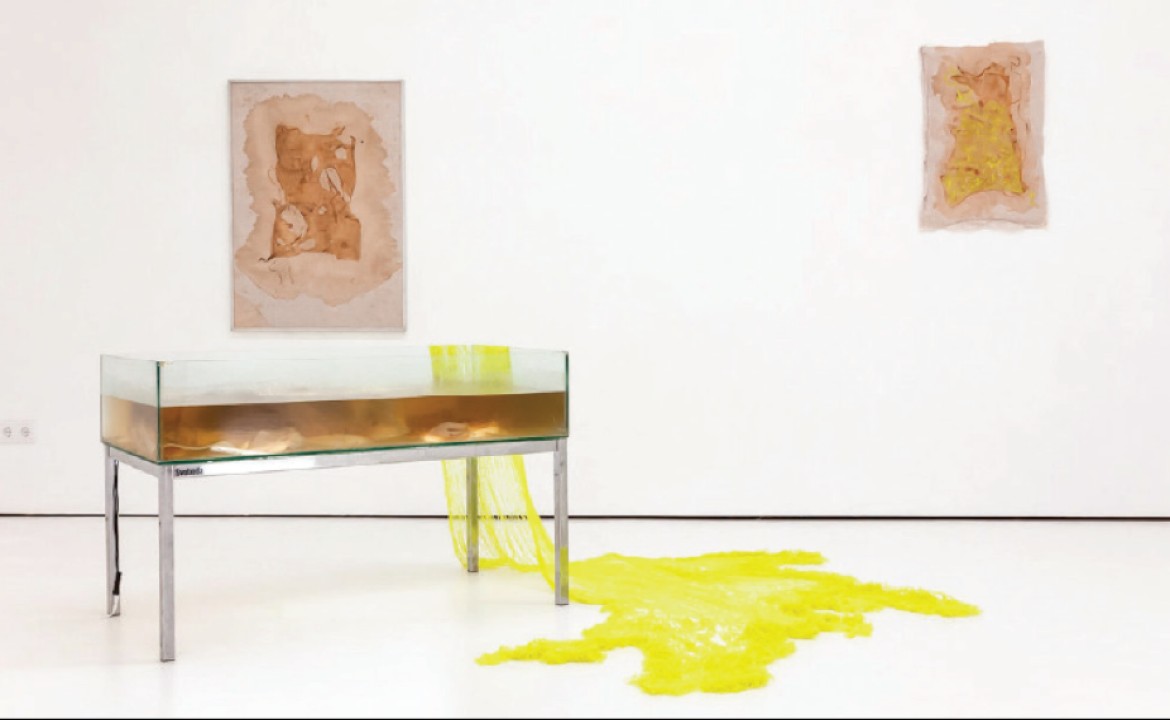
Above: Organelles, 2023,
Tarlatan, dried bacterial cellulose, embroidered salvaged cotton thread. 105 x 52 cm
Below: Passenger VI (detail), 2023, Salvaged glass vitrine and chrome stand, live bacterial cellulose and Geburtsvorbereitungstee tea culture, crocheted dead stock thread. Both from the Guts of my Guts - Series. Photo © Anni Kathrin Elmer
Tarlatan, dried bacterial cellulose, embroidered salvaged cotton thread. 105 x 52 cm
Below: Passenger VI (detail), 2023, Salvaged glass vitrine and chrome stand, live bacterial cellulose and Geburtsvorbereitungstee tea culture, crocheted dead stock thread. Both from the Guts of my Guts - Series. Photo © Anni Kathrin Elmer
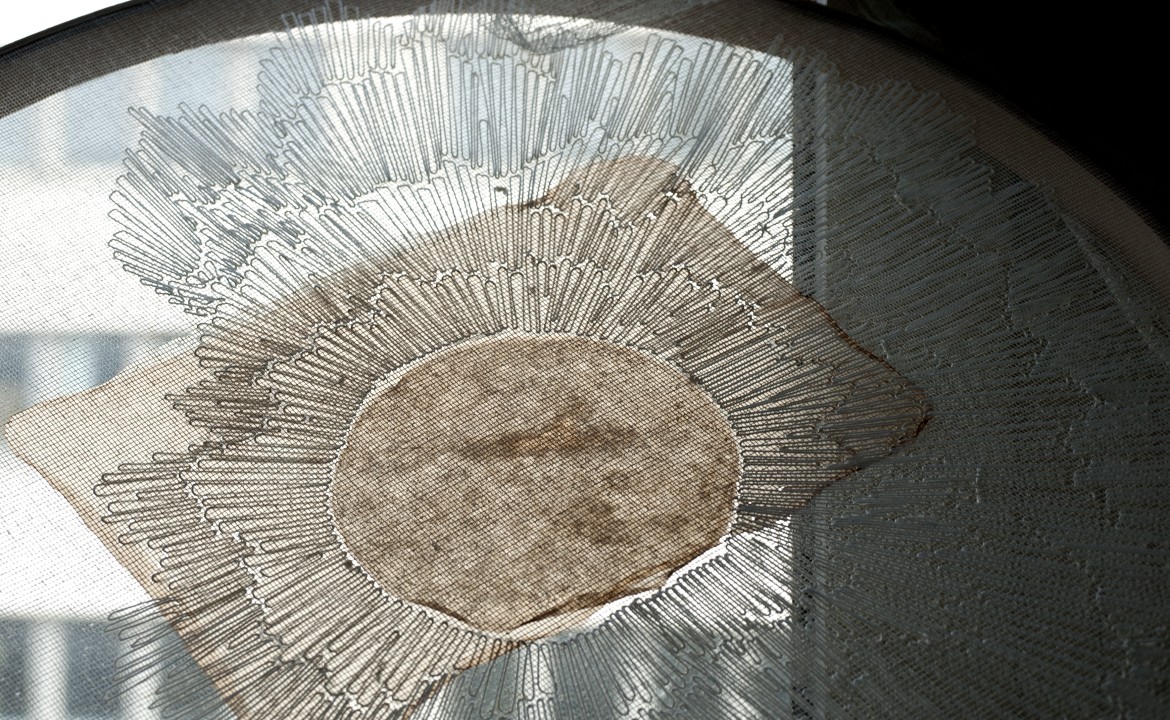
Work in Monica's studio, 2026, Photo © Gerda Tschoerdy Fischbach
Can you tell a bit about your artistic style, what kind of techniques and materials do you use?
My current practice considers the materiality of invisible phenomena that are integral to bodies’ understanding of their ability
to create new realities for communities and the planet. My collaboration with micro-organisms is an essential part of my formal,
activist, and metaphorical practice.
In particular I use found and salvaged fiber, usually from the collections of deceased individuals, to hand-crochet soft sculptures
ranging in size from table-top to room-filling, and embroider onto textiles made from self-grown SCOBYs made through a fermentation
process. Through the algorithmic iterations of my stitching, I am researching and illuminating the compounding and exponential
geometries that exist within subjects like epigenetics, evolution, and theoretical quantum physics’ handling of non-linear
time or superposition theory.
Furthermore my work ties into examining hierarchies of knowledge and power. Through the use of craft and fermentation (which
is essentially a collaboration with microorganisms) in a fine-art context, I speak to topics such as reproductive labor and
matriarchal studies, the importance of embodied (rather than institutional) knowledge, and the essentialism of collaborating
with and honoring our non-human symbionts.
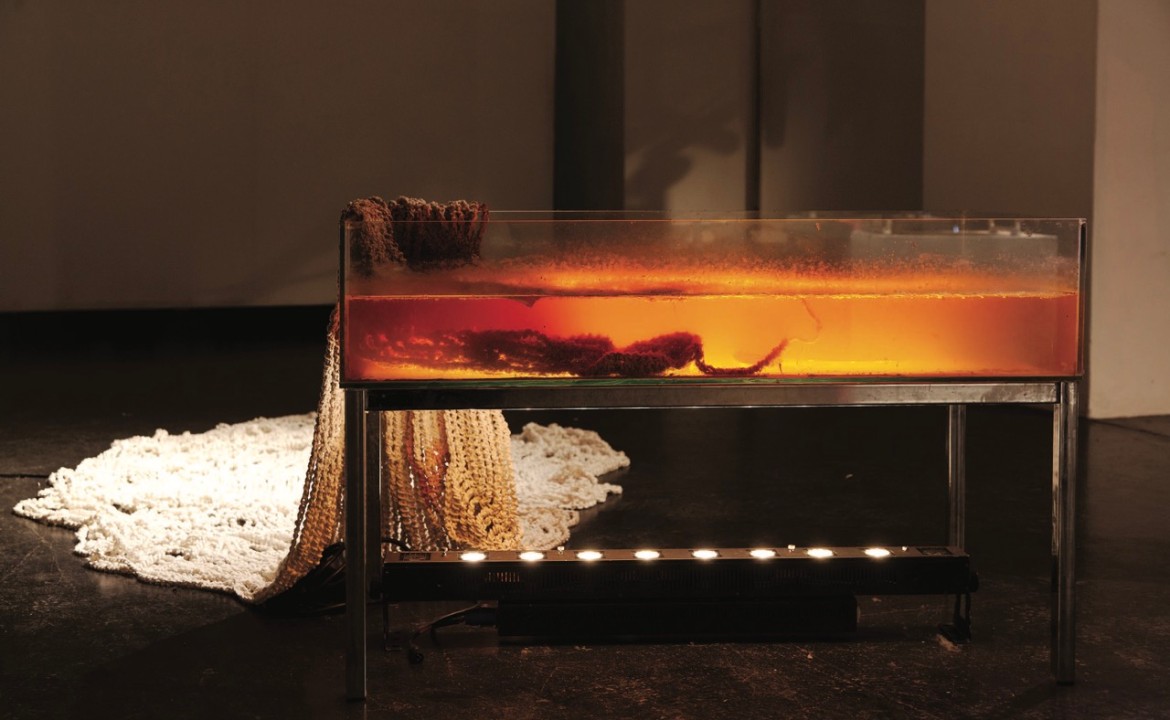
Variations on the Amniote Theme (Passenger VII), 2025
Hand-crocheted organic unbleached cotton cord, salvaged glass vitrine and metal stand, mirror, bacterial cellulose, fermenting
tea, beet juice, flies. Dimensions Variable. Photo © Rois Stubenrach
What would you say brought you there?
My work with epigenetic memory began while working on my master's thesis with Art & Science with research based on my life,
my long struggle with PTSD, how the body holds memory, and the profound healing capacity of repetitive, art-making practices
to heal trauma. It eventually employed research on fermentation, the microbiome, somatic therapies, “outsider” art, non-linear
quantum time theory, and auto-theoretical feminist writing practice. It was also the beginning of my collaboration with microorganisms
and my work with SCOBY (Symbiotic Culture of Bacteria and Yeast).
Since completing my master's in early 2021, my work has continued to be informed by the empowerment, healing, forms, choreographies,
theories, and philosophies that are implicated by the idea of epigenetics. It also brought me to my research on endosymbiosis,
which I find to be a rich metaphorical ground for many of the philosophical topics that guide my work. I am profoundly interested
in how questions instigated by epigenetics contribute to understanding our ancient symbiotic origins, remembering and imagining
our profound connection to other living organisms by examining the geometries of extrapolation and iteration, dreaming better
futures through understanding our bodies’ capacity to evolve, and practicing therapeutic choreographies that illuminate our
ability to heal.
This work has only strengthened my commitment to exploring how memory and information is held in and transmitted by all materials,
and to only using authentic and considered materials in my art works.
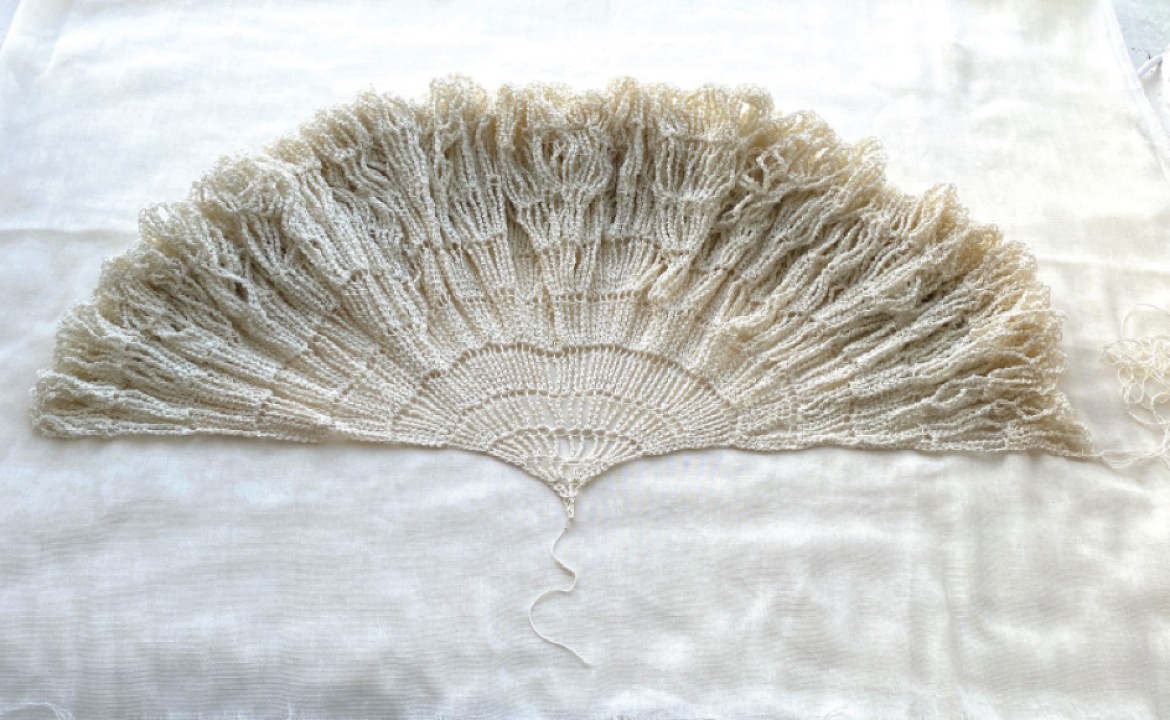
Interpolated Memoriam, 2022. Salvaged cotton crochet thread, 90 x 50 x 8. Installation at Der Goldene Shit Agency, 2022. Photo © Monica C. LoCascio
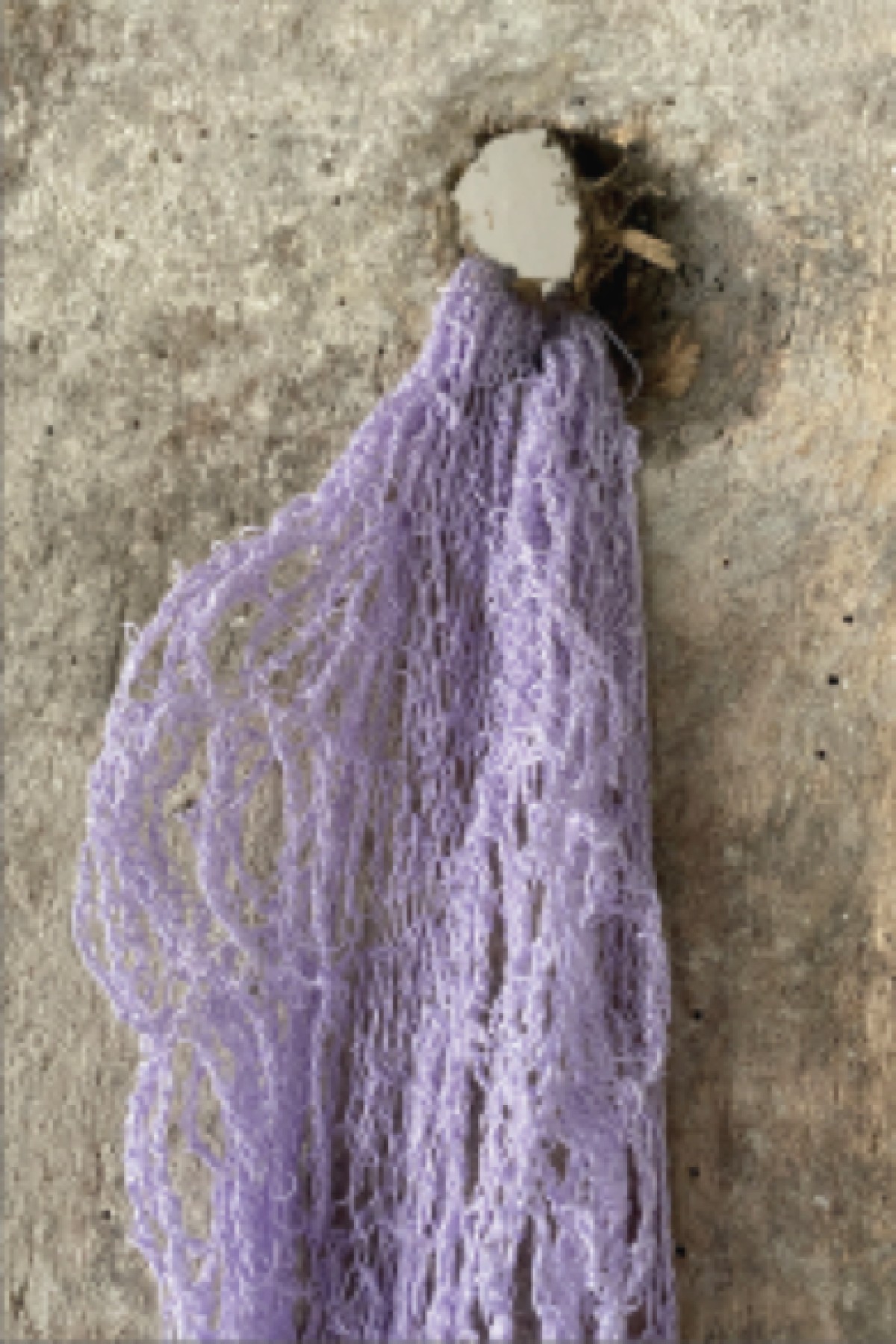
In the Bones of Our House, 2023, Salvaged antique floorboard, salvaged cotton thread, Dimensions Variable, part from the Ancestors Series Photo © Anni Kathrin Elmer
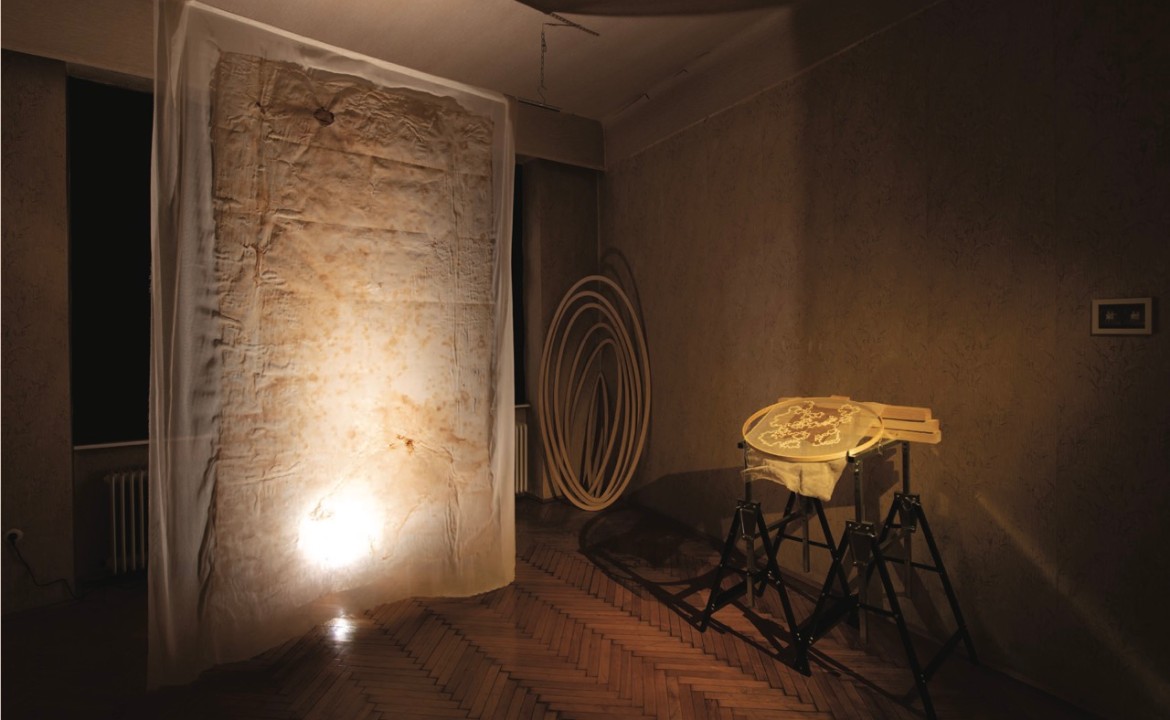
Monica's master's project installation in 2021 © Photo, the artist
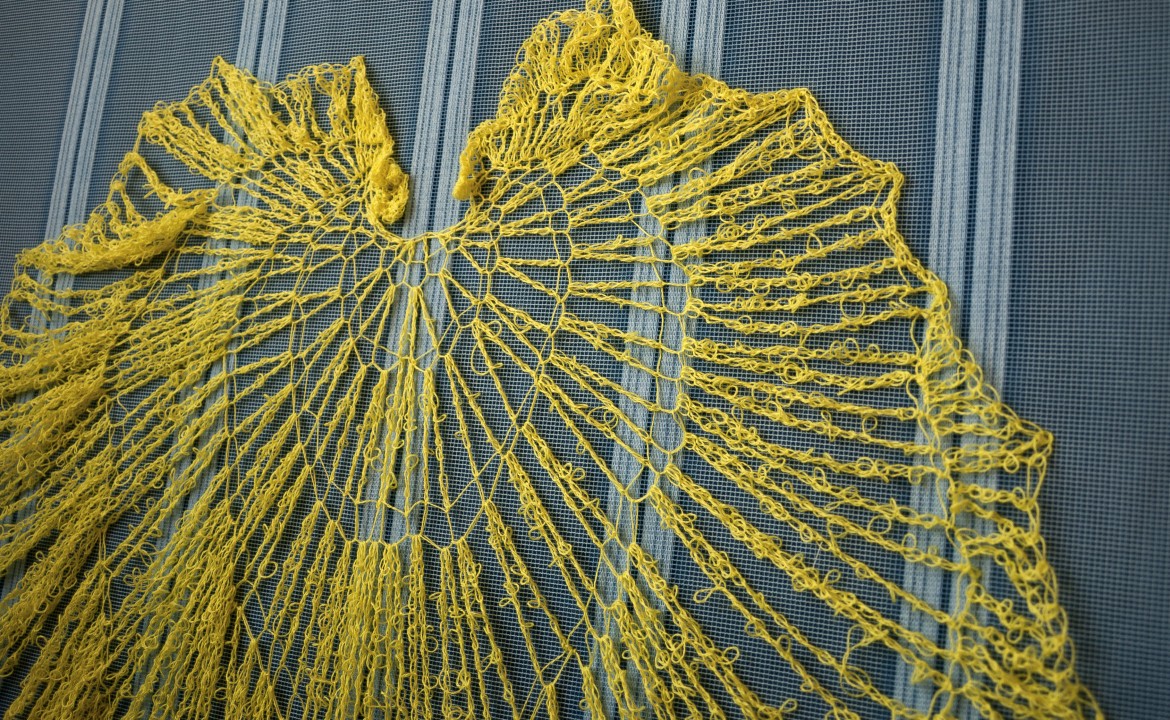
I feel I can also make claims on existence, 2025, Crocheted salvaged wool from NZ, table cloths from my wedding, Amazon blender gift bag
120 x 90 cm, Photo © Gerda Tschoerdy Fischbach
120 x 90 cm, Photo © Gerda Tschoerdy Fischbach
Do you know the patterns or have a concept ready before grabing a needle, or do you sometimes just start and see where it leads you?
Both. I plan the geometry of the pattern and I'm interested in observing something grow. It is actually a lot of counting. When you do something 5 times, you start to see it. If you do something 500 times, you start to get a sense of the pattern. But when you do something 5,000 times, you really understand what that pattern is. Sometimes I notice mistakes much later but still leave them in. And sometimes my intuition event tells me to make a mistake on purpose.
There's a lot of metaphor and philosophy included, in the sense that most of the geometry I am alluding to has to do with quantum physics or epigenetics or evolution.
Does it mean that you always have “research” in mind while stitching?
Often, when I'm working, I'm also listening to an audiobook or podcast on the topic, and so that always feeds into the work and often the title of the piece. If I'm listening to music or sitting in silence, then my mind wanders and I end up making connections and discoveries through the geometries and formal outcomes of the working process.
I like being able to dance around so many different topics, rather like a spiral than a linear line of research. Because I assign meaning to my materials and to the geometries, the learning gets deeper and richer, it opens up another door. I can just follow, but I don't have to finish. That's why I'm an artist and not a scientist. It's wonderful to be able to follow my curiosity; it's my freedom.
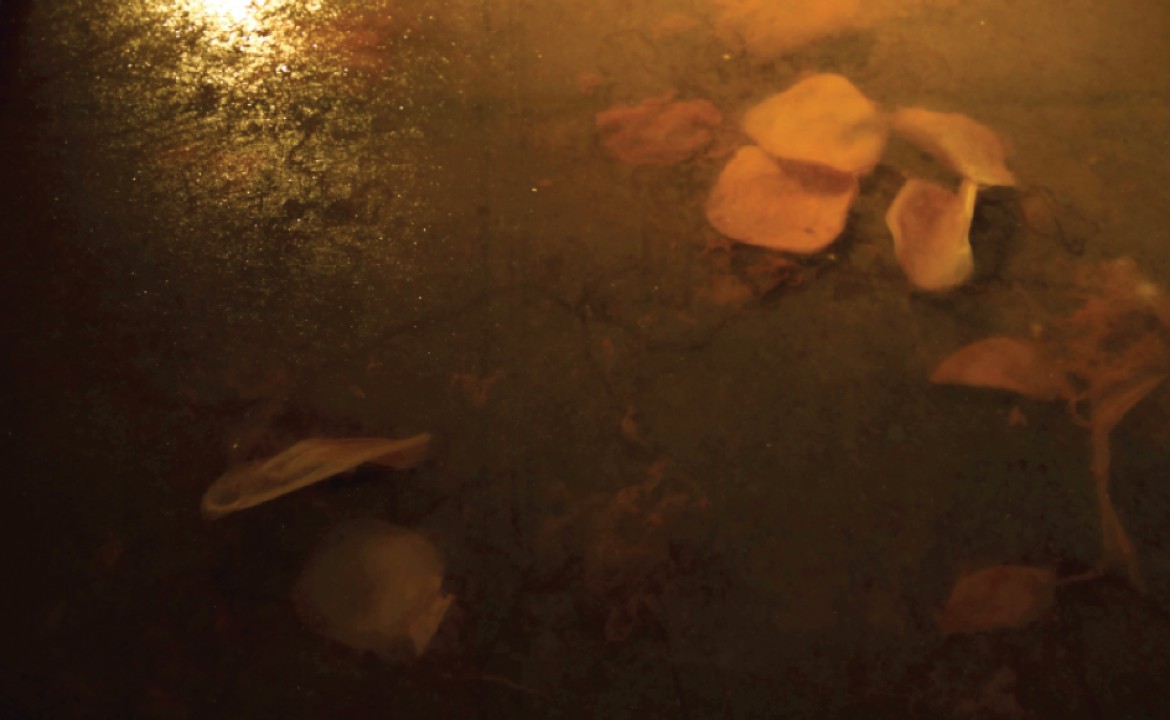
Scoby growing
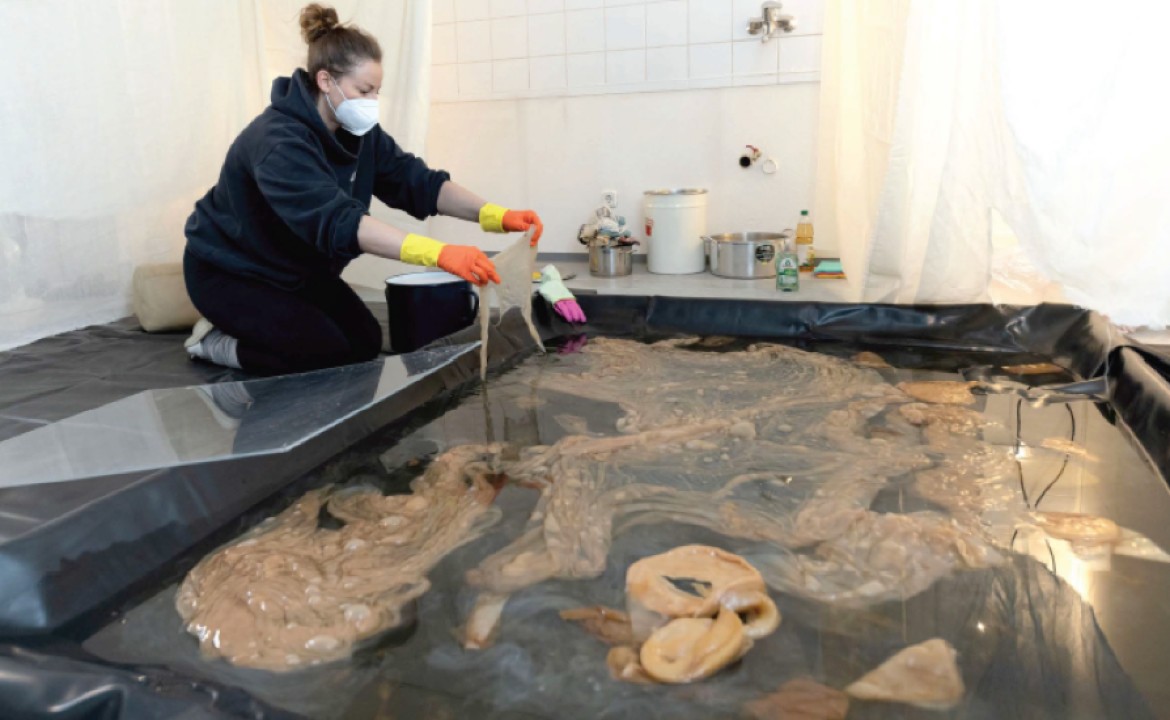
Without us, the system fails - at Vienna Art Week, House of Challenging Orders, 2022
What do you love about working with living beings, bacteria?
On the one hand, it's intuition and on the other, it’s a kind of “collaboration” with bacteria. Our whole evolution, our immune system, our happiness, our
serotonin, our entire body exists because of bacteria.We exist because of symbiosis. But, we live in a world that's all antibacterial, right? Bacteria is performing reproductive labor for humans, but we barely valute them at all. However, if bacteria disappeared, we'd all be dead in half an hour.
Questions arise such as why do we do things and around hierarchies of power and labor, and who's valued and why (and who’s not)? The idea that we can inherit memories through our DNA means that we have the experience of thousands and thousands and thousands of people in us. I like to think about these topics and that illuminate - for me - ways to be a better community member, a better human, a better organism on planet Earth.
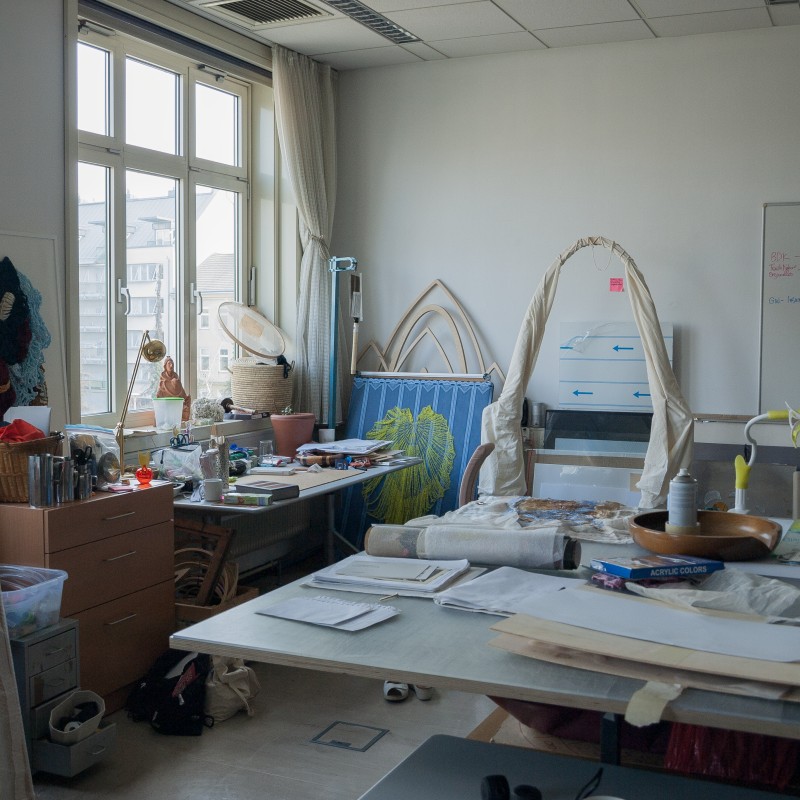
Monica's studio space rented from WESTspace in the 17th district of Vienna. 2026 © Gerda Tschoerdy Fischbach
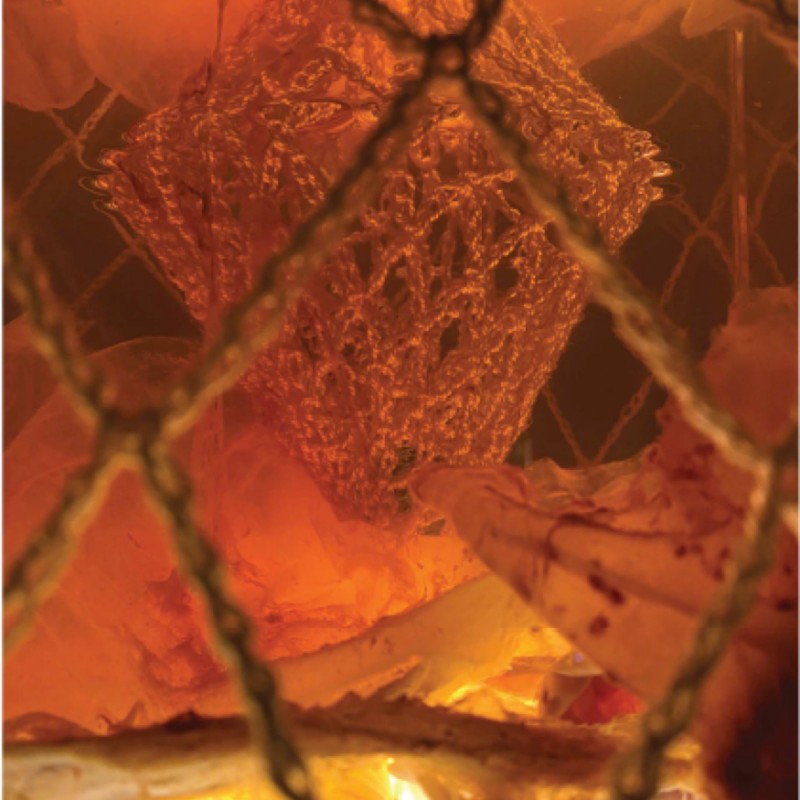
Passenger IV (detail), 2023, Bacterial cellulose in fermenting hibiscus, green and black tea, crocheted salvaged cotton cord, glass marbles,
found cement blocks; during the collaboration with astrophysicist Ulrike Kuchner for SPACELab. Photo © the artist
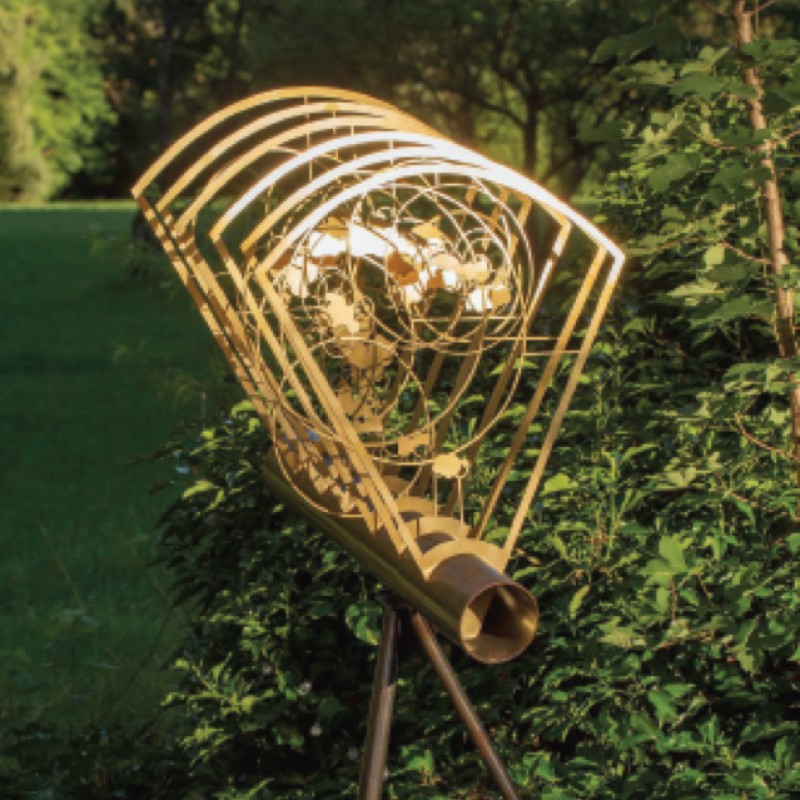
Hold On, 2021
Steel, Brass, 120 x 120 x 170
Steel, Brass, 120 x 120 x 170
Your passion for art started at a very young age. Can you tell us more about that time?
I learned how to crochet and embroider when I was 5 years old. My grandfather’s twin sister, Aunt Mary Lou, and my gramma Dolores taught me. I have vivid memories of sitting on the floor of my gramma’s living room in the summer time crocheting blankets out of bright acrylic yarn. I did it so much that eventually I could crochet without looking.
Imagining that scene seems very comforting.
You are a mother now. How do you manage the work and private life balance?
It’s difficult, but I’m much more productive now. I wasted so much time before I had my kid! Now I am able to prioritize and set boundaries around my time and energy in ways that used to be very difficult for me. I also find myself being much more present in my body and in my practice when I’m in the studio because it is such precious time.
Is your child interested in what you do?
Yes, my kid is already so creative and artistic, and she loves my work, she says it’s “Boofuhloo.”
Back to this space, your current studio, which is coordinated by WESTspace, an organisation you are also working with. Usually, WESTspaces are rented on a temporary basis, which also means that in a few years you need to relocate again?
I'm not afraid of change and it's a natural way of things. Actually, I quite appreciate this aging and changing and living in the movement. Nothing is stable, nothing is certain. The only certainty is change, right?
Word [smiles]. Thank you Monica, for giving us insights and personal thoughts about your life and work. It is always a pleasure
meeting you, so it was today.
Thank YOU Gerda!!
I hope, we will continuously see artwork of yours. Especially your room taking textile sculptures made of natural materials
are very impressing to me.
pdf of Monica's Art & Science Master's Thesis
MONICA C. LOCASCIO
@monicadem
www.monicaclocascio.com/
Monica C. LoCascio @Art&Science
Interview conducted by Gerda Tschoerdy Fischbach, April 2026